

What is structural adhesive
Structural adhesive is a type of adhesive with high strength (compressive strength>65MPa, steel steel tensile bonding strength>30MPa, shear strength>18MPa), able to withstand large loads, and resistant to aging, fatigue, and corrosion. It has stable performance within the expected life and is suitable for bonding strong structural components.
Advantages of structural adhesive
- Easy to use: can be extruded and used at any time.
- Neutral curing: Suitable for most building materials without causing adverse reactions or corrosive effects.
- Excellent adhesion: No need for primer, can form strong adhesion with most building materials.
- Excellent aging stability.
- After curing, it has high modulus performance and can bear an expansion displacement capacity of ± 25% of the interface.
Curing time of structural adhesive
It can be put into use after curing at 20-25 ℃ for 24 hours or curing at 20-25 ℃ for 2 hours+80 ℃ for 2 hours. If the temperature is low, heating or extending the curing time should be used to promote curing.
The use of structural adhesive
Structural adhesive has high strength, peel resistance, impact resistance, and simple construction process. Used for bonding between the same or different materials such as metal, ceramic, plastic, rubber, wood, etc. It can partially replace traditional connection forms such as welding, riveting, and bolted connections. The stress distribution on the joint surface is uniform, and there is no thermal impact or deformation on the parts.
Structural adhesive is widely used in engineering, mainly for strengthening, anchoring, bonding, repairing, etc. of components; Such as bonding steel, bonding carbon fiber, planting reinforcement, crack reinforcement, sealing, hole repair, road nail bonding, surface protection, concrete bonding, etc.
What is weather resistant adhesive
Weather resistant adhesive is a single component, neutral curing silicone sealant designed specifically for various curtain wall weather resistant seals. It has excellent weather resistance and has undergone artificial accelerated climate aging testing, with no significant changes in the physical and chemical properties of the sealant. When in use, use a glue gun to squeeze the glue from the sealant cylinder into the joint that needs to be sealed. The sealant absorbs moisture from the air at room temperature, solidifies into an elastic body, and forms an effective seal.
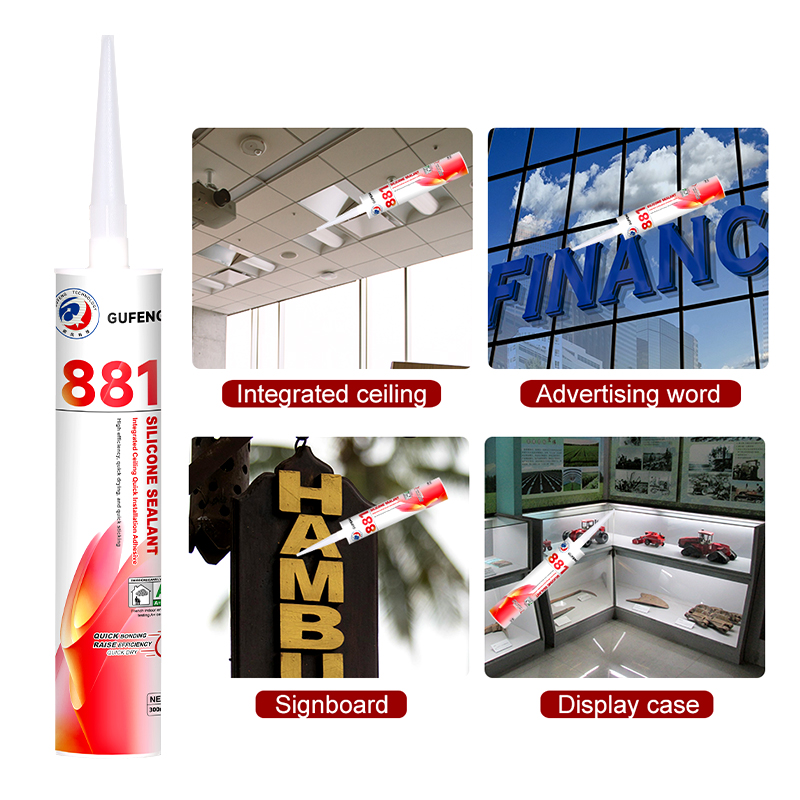
The advantages of weather resistant adhesive
- Single component, easy to use, with good extrusiveness and thixotropy in the temperature range of 4 ℃ to+40 ℃. It can be directly applied by extruding with a glue gun;
- Neutral curing, non corrosive to building materials such as metals, coated glass, concrete, marble, granite, etc., widely used;
- The displacement capability reaches level 20, and this product can maintain its performance unchanged for normal expansion, contraction, and shear deformation of the curtain wall, providing effective sealing;
- Excellent weather aging resistance, aging resistance, UV resistance, ozone resistance, and water resistance;
- Excellent resistance to high and low temperatures, it will not become brittle, harden or crack even at low temperatures of -30 ℃ after curing, and will not soften or degrade at high temperatures of+90 ℃, maintaining good elasticity at all times;
- Having excellent adhesion, it forms a strong bond with most building materials after curing without the need for a primer;
- It has good compatibility with other neutral silicone adhesives.
The use of weather resistant adhesive
- Used for weather resistant sealing of various glass curtain walls;
- Used for weather resistant sealing of metal (aluminum plate) and enamel curtain walls;
- Used for joint sealing of concrete, metal, etc;
- Sealing of roof building joints.
The difference between structural adhesive and weather resistant adhesive
- Different uses
weather proofing sealant
- Suitable for weather resistant sealing of various curtain walls, especially recommended for glass curtain walls, aluminum-plastic panel curtain walls, and stone dry hanging weather resistant sealing.
- Sealing of joints between metal, glass, aluminum, ceramic tiles, organic glass, and coated glass.
- Sealing of joints on surfaces of concrete, cement, masonry, rock, marble, steel, wood, anodized aluminum, and painted aluminum. In most cases, primer is not necessary.
structural adhesive
- Mainly used for structural or non structural bonding assembly between metal and glass in glass curtain walls.
- It can directly connect glass with the surface of metal components to form a single assembly component, meeting the design requirements of curtain walls with fully hidden or semi hidden frames.
- Structural bonding and sealing of insulating glass.
- Function location
Weather resistant sealant is mainly used for sealing and filling joints between materials, as well as waterproof sealing of joints; Structural adhesive is mainly used for bonding structural and non structural assemblies of various curtain walls, and their functions are different.
- Adhesive performance
- Weather resistant sealant, also known as universal adhesive, mainly has the ability to resist extreme weather conditions such as ultraviolet radiation, acid rain, and snow. The displacement ability of weather resistant adhesive (which can be explained as elasticity) is higher than that of structural adhesive.
- Silicone structural adhesive not only has the characteristics of weather resistant sealant, but also has stronger bonding performance than weather resistant sealant, mainly manifested in strong tear resistance, fracture elongation, and tensile strength. Tensile strength is mainly used in pre stressed areas. The modulus, hardness, strength, and price of structural adhesive are higher than those of weather resistant adhesives of the same grade.
Summary: The weather resistance of structural adhesive is as good as or even better than that of weather resistant adhesive, because the weather resistance of structural adhesive is related to safety. If it ages quickly, the consequences of glass falling off are very serious. Therefore, most structural adhesives nowadays are silicone (silicone adhesive), which will not age in natural environments. Weathering glue does not involve safety, and the main result of failure is usually water and air leakage. Therefore, there are many types of materials for weathering glue, including polyurethane, polysulfide, acrylic, etc., but silicone is still the best for weather resistance.